Government buildings are best served by a layered window film approach that addresses solar heat gain on high-exposure glass, forced entry resistance on ground-floor and entry glazing, and screen privacy in sensitive work areas. The right mix depends on a glass-by-glass assessment, not a single product applied across the envelope.
Public buildings face constraints most commercial buyers don’t. Every capital dollar has to stretch across a long service life. Expenditures have to be justified against measurable performance benchmarks. And security requirements add a layer of complexity that residential or standard office buildings simply don’t have.
Window film sits at the intersection of two of those priorities, energy performance and physical security, but the way most government facilities approach it leads to undersized solutions, missed savings, and specifications that fail procurement review.
Requirements vary by agency, building type and jurisdiction, but the principles below apply to most municipal and institutional facilities evaluating window film for the first time or revisiting an existing specification.
The Two Problems Most Government Buildings Are Trying to Solve at Once
Government facility managers rarely approach window film with a single objective. More often, the goal is multi-faceted: improve energy performance to meet sustainability targets, and address the security vulnerability on ground-floor glass.
Those two goals aren’t in conflict. A well-specified window film package addresses both, but only if the selection process treats them as connected rather than separate projects.
The common failure is running two separate conversations: one with facilities maintenance about solar film, and one with security or risk management about safety film. By the time those conversations converge, the specification is already fragmented. Products are layered inconsistently, the glass inventory hasn’t been completed correctly, and installation phases create gaps in coverage.
In government environments, specifications must be defensible. That means performance criteria, glass compatibility and documented test data all need to hold up under procurement review. Getting alignment between facilities, procurement and security teams early in the process is what makes that possible.
Why Film Selection Goes Wrong Early
Most procurement errors happen before a single product is specified. The three most common mistakes, and what they cost:
Specifying by appearance instead of performance. Facility managers often describe what they want by how dark or reflective they want the glass to look. Visible light transmission (the percentage of light a film allows through) matters, but it’s a secondary consideration. The primary specifications are solar heat gain coefficient (SHGC, which measures how much solar energy passes through the glass) and total solar energy rejected (TSER). These numbers tell you what the film actually does to the building’s thermal load.
Treating security film and solar film as separate purchases. They aren’t interchangeable, but they aren’t mutually exclusive either. Solar control films and safety films serve different performance functions and are often applied to different glass areas within the same building. A qualified assessment determines where each type belongs. Without one, the specification defaults to appearance or price.
Skipping the glass inventory. Government buildings frequently have mixed glazing: older single-pane windows in historic wings, newer double-pane low-E glass in renovated sections, and tempered or laminated glass in high-security areas. Not every film works on every glass type. The U.S. Department of Energy notes that tinted films that mainly absorb solar radiation can damage the seals on insulated glass units, and applying the wrong film to low-E glass can void the insulated glass unit warranty.
These missteps reduce performance and lead to rework, warranty conflicts, and specifications that fail internal review or bid comparison.
Avoid specifications that define film by appearance alone or that apply a single product across all glass without verifying compatibility first.
What the Energy Case Actually Looks Like for Public Buildings
Windows are one of the largest sources of unwanted heat gain and loss in a building envelope, and that load is addressed directly by energy-efficient window film for public buildings.
Some of the most relevant evidence comes from the federal government’s own buildings. In a 2017 study for the U.S. General Services Administration, Lawrence Berkeley National Laboratory evaluated low-E window film retrofits on federal buildings in Dallas, Texas, and Ogden, Utah, and modeled performance across seven U.S. climates. The film reduced combined heating and cooling energy in perimeter zones by about 20% compared with a standard tinted film, with simple paybacks of roughly four to six years on full installed cost. Based on those results, the report recommended low-E applied film for wide deployment across GSA’s portfolio.
For facilities operating under fixed annual budgets, reducing HVAC load is one of the few ways to control long-term operating costs without major capital replacement. Because government buildings are typically held for decades, even incremental improvements in annual energy performance compound into significant long-term savings. That’s the lifecycle cost argument, and it’s what makes window film a strong candidate in capital planning conversations, not just maintenance ones.
For facilities pursuing LEED or sustainability benchmarks, window film can support LEED-related energy performance criteria when properly specified. It is one documented pathway in that process, not a guarantee of specific points.
What the energy case doesn’t support is promising specific savings for a specific building without a site assessment. Variables including climate zone, building orientation, occupancy patterns and HVAC efficiency all affect actual performance. The GSA study makes the same point, recommending a site-specific energy model before a product is selected. Any vendor projecting a precise percentage reduction without a building audit is overselling. Request projections tied to your actual glass area and climate data, and ask for manufacturer documentation to support them.
Security Film for Government Facilities
Security requirements for government buildings vary significantly by agency, occupancy type and threat profile. Security window film for government buildings can help meet certain forced entry resistance and glass hazard objectives, but it’s important to understand what film does and doesn’t do.
Safety and security window film helps hold shattered glass together and can slow down forced entry attempts. In the event of impact from a break-in, vandalism or accidental breakage, the film helps contain glass fragments and maintain a barrier for additional time. Properly specified security film systems may also include attachment systems that anchor the film to the window frame, which can meaningfully improve performance under impact. This is a genuine safety improvement and a documented deterrent. It is not a substitute for laminated glass or ballistic glazing where those specifications are required.
For government facilities, the relevant questions before specifying are:
- Which areas of the building carry the highest forced entry or impact risk?
- Are there high-occupancy areas where glass breakage would most directly affect people, such as lobbies, waiting areas or courtrooms?
- Has the specifying authority identified applicable performance standards, and if so, does the film under consideration have documented test data to match?
All performance claims should be supported by manufacturer documentation and test data that can be included in bid or procurement records. Do not write a specification implying compliance with GSA, ASTM or UL standards without confirming the specific film product has been tested to those standards and that documentation is available.
Commercial safety and security film is the appropriate starting point for most government applications. For facilities with elevated threat profiles, Tint USA’s qualified installers can assess each glass area and recommend appropriate film weights and attachment systems. More on the combined approach is covered in hardening soft targets with window film, which addresses institutional and public facility applications directly.
The Products That Belong in a Government Specification
The right product for any government facility depends on which areas you’re addressing and what problem each zone needs to solve. No single film type covers every scenario.
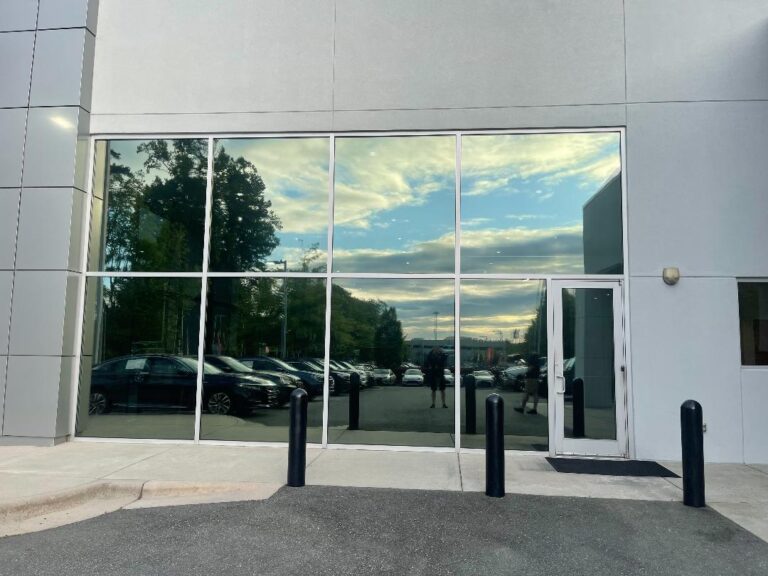
Solar Control Window Film belongs on south- and west-facing glass, skylights and any glazing that drives significant heat gain. This is the primary energy performance product and typically covers the largest square footage in a facility.
Safety and Security Window Film belongs on ground-floor exterior glass, entry vestibules and any area with elevated forced entry or glass hazard risk. In schools and public safety buildings, it often extends across a much larger share of the envelope.
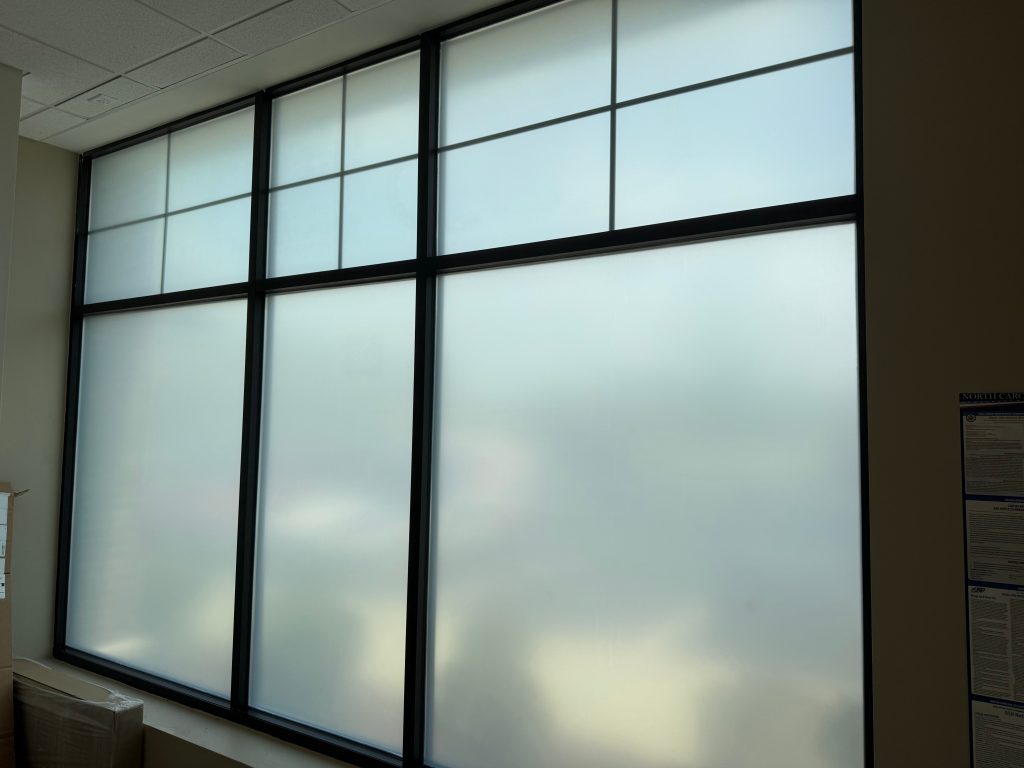
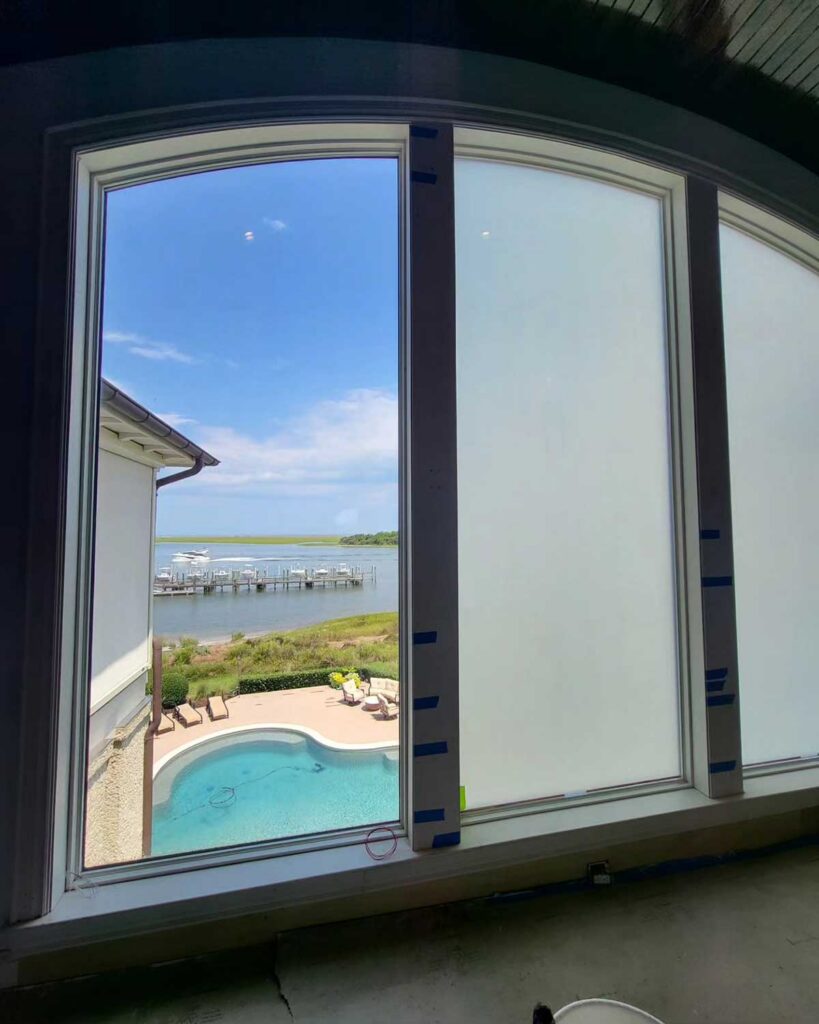
Smart Switchable Film is appropriate for conference rooms, interview rooms and administrative areas that require on-demand privacy without permanent frosting. It eliminates the need for blinds or curtains in applicable spaces.
Cloaking Film addresses a specific problem in government environments: screens displaying sensitive data that are visible through glass partitions or exterior windows. In law enforcement, administrative or data-handling spaces, screen visibility is a genuine security concern that film can resolve without replacing the glass.
The combination of solar control film and security film can sometimes be achieved with a single product, and sometimes requires separate application depending on performance requirements and glass type compatibility. During initial consultations, Tint USA technicians take glass inventory and performance assessment to determine which approach is appropriate.
What to Ask Before You Specify Anything
A defensible government specification for window film starts with answers to the following. These are standard evaluation steps for any commercial or institutional window film project.
What types of glass are in the building, and where?
Single-pane, double-pane, tempered, laminated and low-E glass each carry different film compatibility requirements. This step is not optional. Film applied to an incompatible glass type can void the insulated glass unit warranty and require full removal and reinstallation.
What is the occupancy and threat profile for each zone?
Identify which areas carry elevated security risk and which are primary occupancy zones where glass breakage would most directly affect people. The answers determine which product belongs where, and at what specification weight.
What does the energy baseline look like?
Document the current energy cost per square foot and any facility-level reduction targets before soliciting proposals. Film projections should be calibrated against real baseline data. Generic estimates are not a defensible basis for a procurement decision.
The remaining checklist items are standard practice and should be confirmed with any vendor before a specification is finalized:
- Warranty documentation: confirm coverage on the film and the installation separately. Ask specifically how the warranty applies to a government or institutional application.
- Performance documentation: all performance claims should be supported by manufacturer test data that can be included in bid or procurement records.
- Installation phasing: government buildings are occupied. Confirm the plan for scheduling around occupancy hours and ask how the job site is managed between phases.
How Tint USA Works with Institutional Clients
Government and institutional projects require more process discipline than a standard commercial installation, for which Tint USA’s approach is well-suited.
Every engagement begins with a glass inventory. Technicians identify and meter each glass type in the facility, which determines which films are compatible and where each product belongs. Multiple labeled film samples are installed on the actual windows before any commitment is made, giving decision-makers performance data tied to their specific glass rather than a manufacturer’s catalog.
For multi-building or phased projects, installation can be scheduled around occupancy requirements, with consistent workmanship and clean job sites across all phases.
If your facility is in the Charlotte metro or anywhere in the Carolinas, schedule a site consultation to evaluate your building’s glass inventory, energy performance targets and security requirements before finalizing a specification. If you’d like to see the standard of work first, Tint USA reviews is a good place to start.
Sources
- Lawrence Berkeley National Laboratory for the U.S. General Services Administration, Low-e Applied Film Window Retrofit for Insulation and Solar Control, February 2017.
- U.S. Department of Energy, Energy Saver, Energy Efficient Window Attachments.