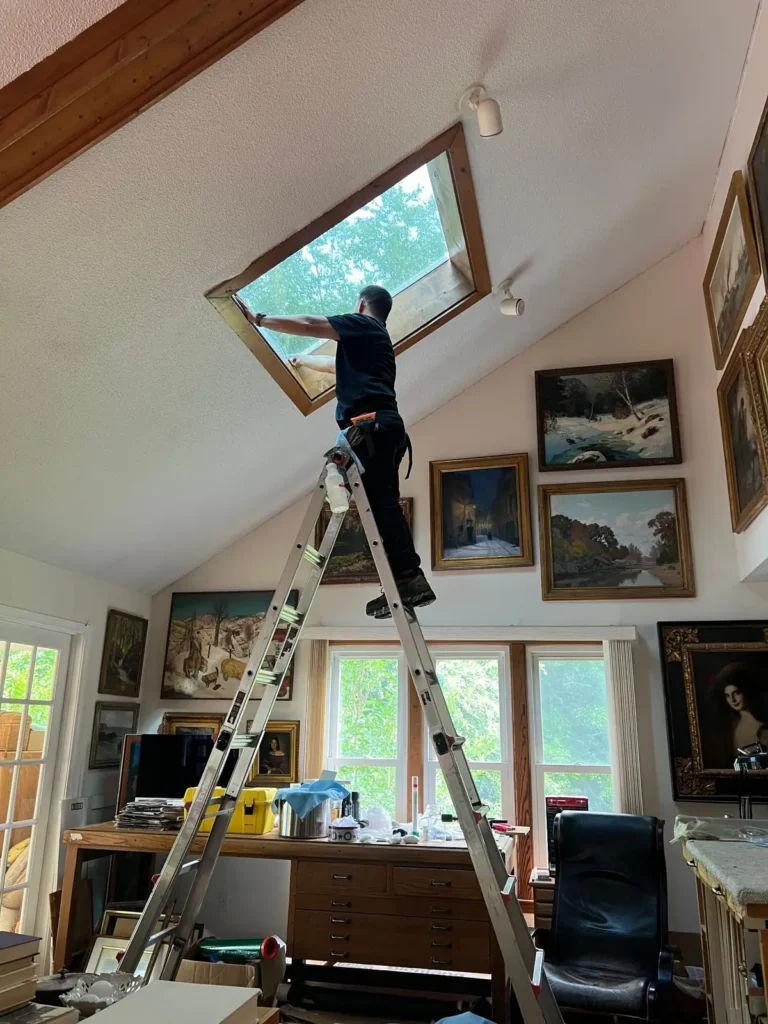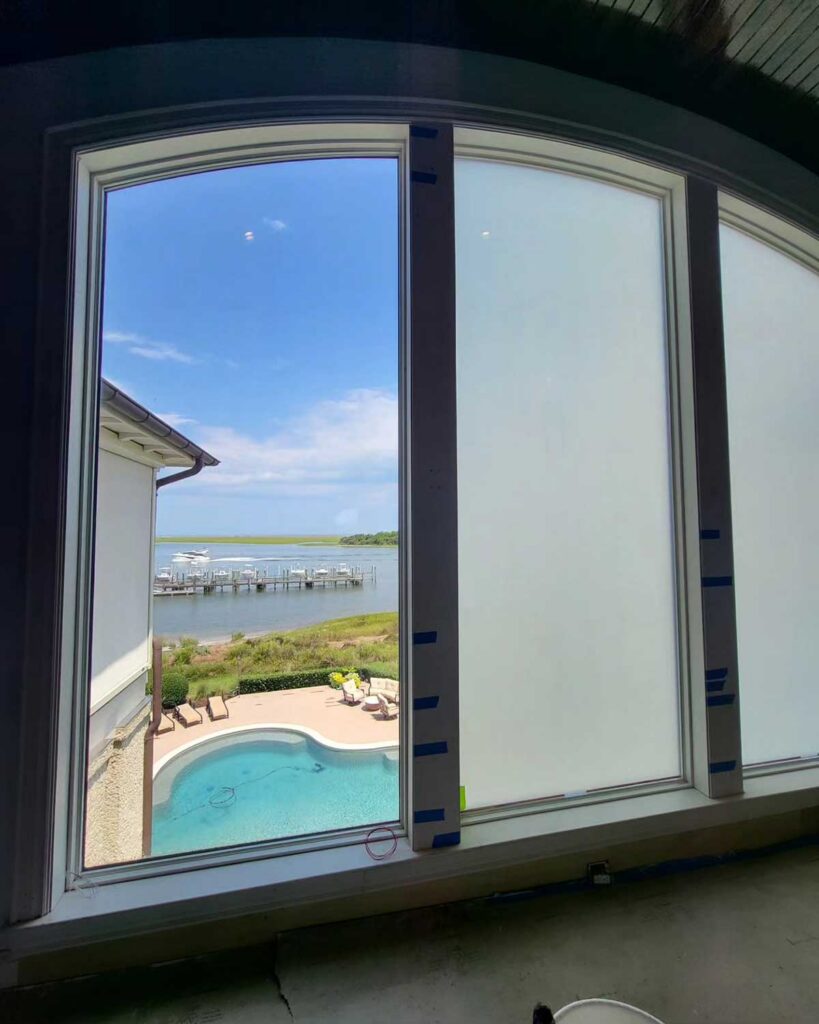
Glass walls look great until someone needs privacy. Then come the awkward blinds, the dusty curtains, or the frosted film that kills the view permanently. Smart switchable film solves that problem by turning any glass surface from clear to frosted in less than a second, and back again with the flip of a switch.
It is not a universal replacement for blinds, frosted film, or solar control products. But for the right application, nothing else performs like it.
If you’re weighing smart film installation for a conference room, a glass office partition, or a residential space, here’s what to consider.
The Privacy Problem Smart Film Solves
Open floor plans and glass-heavy architecture define modern commercial design. Floor-to-ceiling glass lets natural light move through a building and signals transparency and collaboration. The tradeoff is obvious: there is no privacy when you need it.
Conference rooms are the most common example. A glass-walled meeting room works well for the culture. It does not work during a sensitive personnel conversation, a client negotiation, or a board presentation. Blinds gather dust and break. Frosted film is permanent. Smart film is neither.
The same dynamic plays out in healthcare spaces where glass enables supervision but privacy is legally required, in executive offices where glass walls are an asset until they aren’t, and in residential spaces where a glass bathroom partition or bedroom divider needs to switch on demand.
Smart film gives glass a privacy mode.
How Does Smart Film Work?
Smart switchable film is a thin window film, roughly the thickness of a credit card, that applies to existing glass and connects to a low-voltage electrical circuit. In its default state it appears frosted. Apply power and it clears.
The technology is called PDLC, which stands for Polymer Dispersed Liquid Crystal. The film contains millions of microscopic liquid crystal droplets suspended in a solid polymer layer, sandwiched between two transparent conductive coatings.
When power is off (default, frosted): The liquid crystal molecules orient randomly. Because their refractive index, the degree to which they bend light, doesn’t match the surrounding polymer, light scatters in all directions at every droplet boundary. With millions of these scattering points per square centimeter, the glass appears uniformly frosted.
When power is on (clear): An alternating current of 48 to 65 volts forces the liquid crystals to align parallel to the electric field. Once aligned, their refractive index matches the surrounding polymer. Light passes straight through. The glass goes clear.
Switching takes 10 to 100 milliseconds, faster than a blink. The film consumes 3 to 5 watts per square meter while transparent and zero watts in its default frosted state.
One behavior worth understanding upfront: if power goes out, the glass reverts to frosted automatically. That is the right default for healthcare, bathrooms, and security-sensitive spaces. For applications where default-clear is preferred, storefronts and lobbies for example, reverse-operating variants are available. Because the clear state requires power, continuous transparency also depends on a functioning electrical supply and control system, which facilities teams should factor into their planning.
What the Film Looks Like
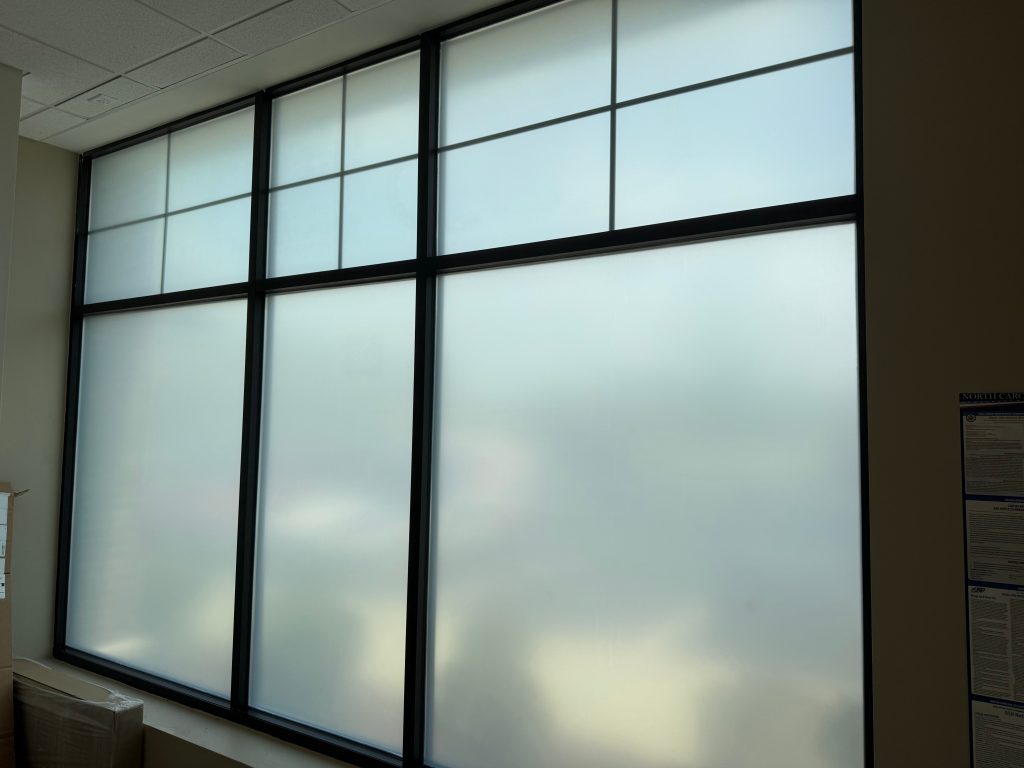
Frosted (off): The film produces a smooth, uniform milky-white frost similar to acid-etched or sandblasted glass. The frosted state provides visual privacy, not full opacity. Light passes through and faint silhouettes may be perceptible under certain lighting conditions, particularly when strong interior lighting contrasts with a dark exterior at night. Rooms stay well-lit regardless: the film scatters light rather than blocking it, so spaces stay bright with a soft, diffused glow.
Clear (on): Premium film achieves 80 to 85 percent or better visible light transmittance. A slight residual haze in the clear state is normal; most people don’t notice it in use, though it exists. The clear state performs essentially like standard glass with no visible tint under most conditions.
Both states look the same from both sides of the glass.
Standard film comes in white, which is the most optically neutral in the clear state. Grey, black, and colored variants are available but carry a visible tint even when powered on.
What Installation Involves
Applying Film to Existing Glass
Smart film uses dry application, no water, no solution. The film adheres directly to the glass surface with a pressure-sensitive adhesive. Glass must be cleaned thoroughly with isopropyl alcohol before installation; a single dust particle trapped under the film can create a visible bubble that typically requires panel replacement to correct.
Panels ship pre-wired with thin copper bus bars along one edge. These distribute voltage evenly across the film. The bus bar edge is trimmed with a cover profile or concealed behind framing.
One structural limitation to plan around: the maximum panel width is 71 inches. For glass surfaces wider than that, multiple panels are joined with a small gap. That seam is visible, particularly noticeable in the frosted state. For larger glass walls, panel layout should be planned early so seams align with mullions or framing where possible. Installation requires clear access to the glass surface and nearby power routing, which should be factored in for occupied or fully furnished spaces.
Most projects are completed within one to three days depending on glass size and electrical complexity.
The Electrical Requirements
The film operates on 48 to 65 volts AC stepped down from standard household current through a dedicated transformer, typically one 100-watt unit per 120 square feet of film. Undersized transformers cause flickering and shorten film life.
A licensed electrician is required to connect the transformer to mains power. Budget $200 to $500 per zone for that work, separate from film and installation costs. Final pricing varies based on panel size, electrical complexity, control integration, and total project square footage.
Smart film works on float glass, tempered glass, laminated glass, and tinted glass. It does not work on textured, patterned, or wire-reinforced glass. Double-pane windows require a glass-type assessment before installation, as thermal stress on the sealed unit varies by specification.
In typical commercial use, smart film systems are designed for 10 to 20 years of service life depending on usage patterns and electrical configuration. Maintenance is minimal: standard glass cleaning only, with care taken to avoid moisture exposure at film edges.
Control Options
- Wall switch or remote control: the standard configuration for most installations
- Smartphone app: enables scheduling, timers, and remote access
- Voice command: compatible with select smart home platforms depending on the controller specified
Advanced integration with commercial building platforms and automation systems is available depending on the controller. Your Tint USA specialist will confirm compatibility during the consultation.
How Smart Film Compares to the Alternatives
Not every privacy problem requires smart film. Here’s how it compares to other window coverings.
| Option | Approximate Installed Cost | Smart Home Compatible | Privacy Type | Lifespan |
| Static frosted film | $8–$15 per sq ft | No | Always-on frost | 10–15 years |
| Blinds or shades | $7–$21 per sq ft equiv. | No | Adjustable / blackout | 6–20 years |
| Motorized shades | $400–$1,500 per window | Yes | Adjustable / blackout | 10–15 years |
| Smart film (retrofit) | $75–$125 per sq ft | Yes | Switchable clear / frost | 10–20 years |
| Factory smart glass | $100–$200+ per sq ft | Yes | Switchable clear / frost | 20–30 years |
If privacy is always required or cost is the primary concern, decorative and frosted film is usually the better fit. Smart film earns its cost premium specifically when switchability matters, the glass cannot accommodate hardware, and the open-glass look is part of the design intent.
What Smart Film Does Not Do
These are the points that matter most before committing to a project.
It is not a solar control product. Conventional PDLC film rejects only 10 to 20 percent of solar heat gain. If reducing heat and lowering cooling costs are the primary goal, commercial solar window tint is the right product. Smart film and solar film solve different problems.
It does block UV effectively. Up to 99 percent UV rejection (varies by film) in both states protects interiors from fading whether the film is on or off.
It is not waterproof. Self-adhesive retrofit film is moisture-sensitive. Water reaching the film edge while powered can cause irreversible damage. Bathrooms, spa areas, and exterior-facing glass with condensation exposure require laminated smart glass, not retrofit film.
It does not provide acoustic privacy. Conversations remain audible through glass-walled spaces unless additional soundproofing measures are in place.
It needs periodic rest. Liquid crystals degrade if held in the clear state continuously. The film should cycle off for at least a few hours each day. A timer switch handles this automatically and is worth adding to any installation.
How Much Does Smart Film Cost?
Total professionally installed cost runs $75 to $125 per square foot, covering film, application, wiring, transformer, trim, and electrical connection.
Typical project ranges:
| Application | Estimated Installed Cost |
| Conference room (100–170 sq ft of glass) | $7,500–$21,250 |
| Single glass partition or office wall (40–60 sq ft) | $3,000–$7,500 |
| Residential glass room divider (20–50 sq ft) | $1,500–$6,250 |
| Residential bathroom window (4–8 sq ft) | $500–$1,200* |
*Small jobs carry project minimums, so the per-square-foot rate runs higher.
Ongoing electricity costs are negligible. The film draws power only in the transparent state, consuming roughly the equivalent of a small LED bulb per standard window per year.
For comparison: retrofitting an existing 100-square-foot conference room wall with smart film typically runs $7,500 to $12,500. Replacing that same glass with factory smart glass typically costs $10,000 to $20,000, and more when the job requires glass removal, new framing, or custom sizes. When the existing glass is in good condition, the retrofit delivers comparable privacy function at a lower cost and with less disruption.
Where Smart Film Makes the Most Sense
Conference rooms are the strongest commercial application. The ability to switch from open to fully private in under a second, integrated with room booking software and building automation, solves a genuine problem in virtually every glass-walled commercial building. This is where smart film earns its cost premium most clearly.
Healthcare environments make a stronger case than aesthetics alone. Hospital fabric privacy curtains are a documented vector for infection. Smart glass eliminates that surface entirely, cleans like any other glass, and provides on-demand visual privacy that can support HIPAA-compliant environments when properly implemented. For healthcare clients, smart film is as much a hygiene upgrade as a design one.
High-end residential installations center on glass bathroom partitions and open-plan room dividers where the goal is maximum light with switchable privacy: no curtains, no tracks, no visible hardware. Residential smart film is a niche application where the premium is clearly justified by the result.
Smart film is often specified early in design phases for new construction, but retrofit installations are common whenever the existing glass is in good condition and electrical routing can be cleanly integrated.
For commercial smart film projects across the Charlotte metro, Concord, Mooresville, Fort Mill, Rock Hill, and throughout the Carolinas, Tint USA’s installation specialists assess the glass, framing, and electrical routing before any product is specified. The right film and control configuration depend on how the space is actually used.
Is Smart Film Right for Your Space?
Smart film is a strong fit when:
- The glass cannot accommodate hung hardware (partitions, frameless walls)
- Switchable privacy is genuinely needed, not just always-on frosting
- Design requires that the glass look unobstructed when clear
- The space is dry and the glass edges can be properly sealed
Consider other options when:
- Full blackout is required; motorized shades or blackout film serve this better
- The primary goal is heat and energy management; solar window film is the right product
- The glass is in a wet environment and the budget doesn’t support factory laminated smart glass
- Static privacy is sufficient; frosted film costs far less and lasts just as long
If you’re evaluating smart film installation and need a clear answer on fit, cost, and configuration, that’s exactly the conversation to have before committing to a project.
Contact Tint USA to schedule an on-site assessment for a smart film project anywhere across the Carolinas and into Southern Virginia.